
Who buys property in Thailand: China, Myanmar and Russia take 54% of foreign freehold
Buyers from China, Myanmar and Russia account for 54% of the condominium units foreigners buy freehold in Thailand. Each has its own reason: falling prices at home, protecting capital, and income in a stable currency.
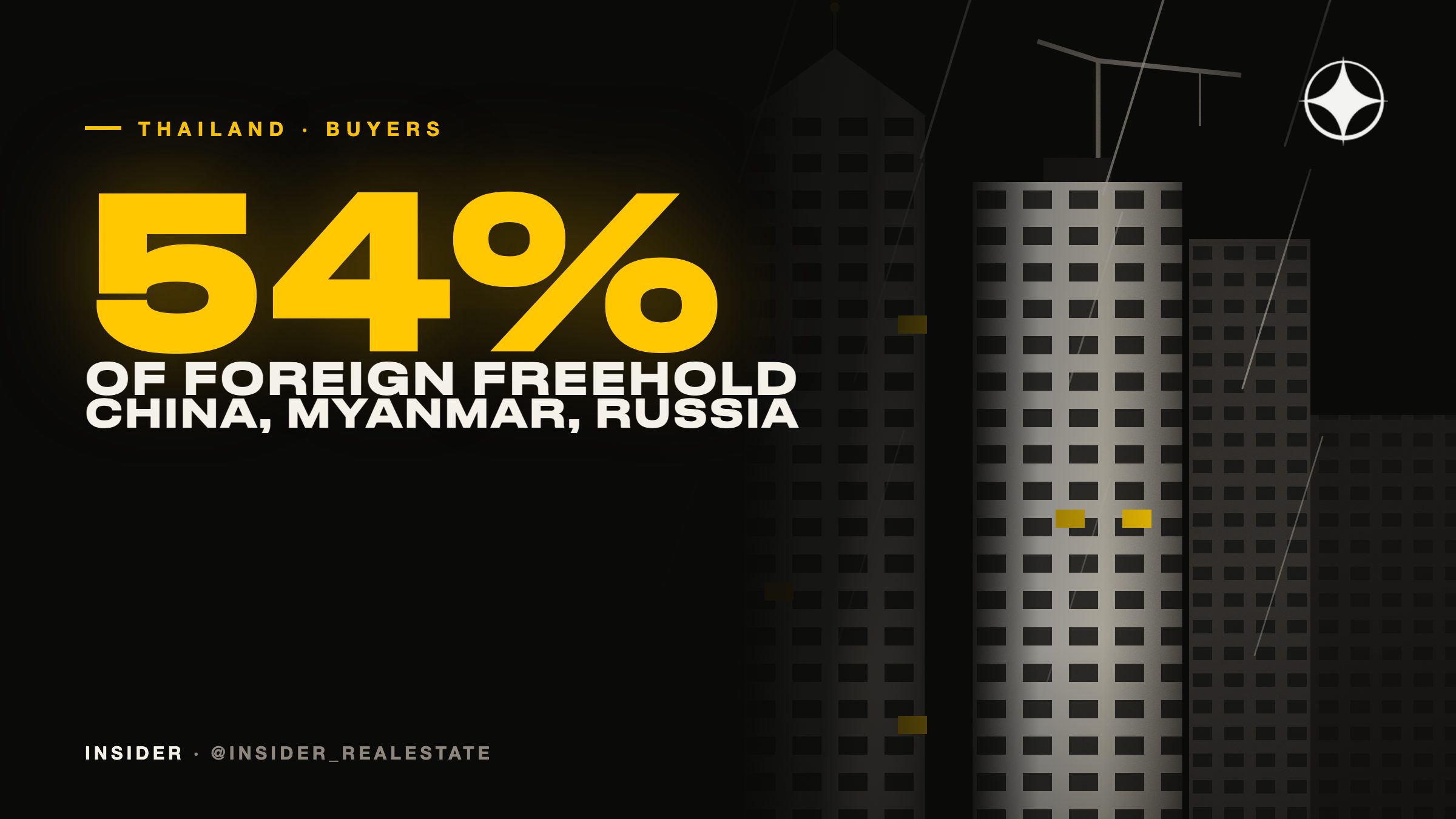
More than half of the condominium units foreigners buy freehold in Thailand — 54% — go to buyers from three countries: China, Myanmar and Russia. Taiwan, European countries, the US, the UK and India follow. The figures come from a practitioner with 12 years in the Thai market, speaking at our closed session for brokers.
Who buys property in Thailand most often?
The main buyer nationalities are China, Myanmar, Russia, Taiwan, European countries, the US, the UK and India. The first three account for 54% of freehold purchases in condominiums.
This is about units registered in the foreigner's own name. It is the only form of full ownership open to foreigners, and it is capped by a quota: see our piece on the 49% condominium quota.
Talk to a licensed broker: 📲 +971 50 120 32 64 on WhatsApp, @dubai_oleg on Telegram
Why do Chinese buyers come?
Property in China has become cheaper: in a number of cities prices are roughly 25% below their 2020 level. For a Chinese buyer, a unit in Thailand is a way to move part of their capital out of the country.
The second reason is children. Competition for a place at a good Chinese school is fierce, so families bring their children to study at international schools in Thailand. The purchase follows the school.
The third is a clean, documented result: official income from rent and from resale, a foreign bank account and a card.
Why do buyers from Myanmar come?
Myanmar is under military rule. There is money in the country, but its owners do not know when they might lose it, and they look for somewhere to move their capital.
This buyer hardly asks about yield. Whether it is 6% or 7% a year does not matter: the aim is to keep the money safe in a neighbouring country where banks and courts work.
What are Russian buyers looking for?
For Russians, Thailand offers income in a stable currency: according to the speaker, the baht holds its rate against the dollar far more steadily than the rouble. Add a foreign bank account that is opened without difficulty.
- payment by QR code almost everywhere;
- transfers by phone number;
- cards for tourists issued by Thai banks.
There is an everyday reason too: the owner lives in the unit for half the year. How to work that into the numbers is covered in our review of long stays in Thailand.
Buyers from the Gulf states
A separate group is residents of Bahrain, Kuwait, the Emirates and Saudi Arabia. They visit Thailand in large numbers, but it is not something people talk about at home.
That creates a risk few think of: the family does not know the unit exists. We explain how that ends in our piece on inheritance in Thailand.
What this means for a buyer from Dubai
The Thai market rests on three different motives: protecting capital, personal use and diversification. Yield is not the main argument here — it runs at 4–6% net.
According to the speaker, after the first unsettling news in the region some clients of Dubai brokers went to look at Thailand. In March the brokers themselves travelled to Phuket and Pattaya — more in our piece on how to choose a broker in Thailand.
Frequently asked questions
What share of foreign purchases goes to China, Myanmar and Russia?
54% of the condominium units foreigners buy freehold. The rest is shared by Taiwan, European countries, the US, the UK and India.
Can a Russian citizen open an account with a Thai bank?
Yes; according to the practitioner, the account is opened without difficulty. QR-code payments and transfers by phone number are available, and banks issue separate cards for tourists.
Do people buy in Thailand for the yield?
Rarely. Net rental yield is 4–6% a year. The main motives are keeping capital outside the home country, living in the unit for part of the year and spreading assets across markets.
Video on this topic
The same subject on the English channel — each clip has a written version of its own.


Related reading
Other write-ups on the site about the same thing.
Thailand tourism in 2025: 32.97 million visitors — and why the economy does not depend on them
Thailand received 32.97 million foreign tourists in 2025, and Thais themselves made 202 million trips within the country. Yet the backbone of the economy is goods exports: electronics, cars and machinery.

Thailand Property for Foreigners: The 49% Condo Quota and Why Land Isn't for Sale
Foreigners can own a Thai condo unit outright, but only within 49% of a building's floor area. Land can't be bought at all. The quota, the 30-year lease, and the schemes that don't hold up.

Thailand or Dubai: five reasons buyers choose Thailand, and three reasons they do not
In Thailand people buy a way of life, not square metres: a studio from AED 200,000, inspection before the final payment, an open contract. Against it: a 4–6% yield, no escrow and a slow resale.
Property liquidity in Thailand: selling a unit takes from 5 months to 2 years
A resale unit in Thailand takes from 5 months to 2 years to sell. There is no single listings portal, agents are busy with new builds, and buyers are found through social media and mailing lists. What that means for your exit.

Thailand: the LTR, the Elite card and the retirement visa
Three products sold in the same conversation and legally very different. One is a residence framework, one is a long-stay tourist privilege, one is an annual renewal with a bank balance.

Taxes and Costs of Owning a Condo in Thailand: Buying, Holding and Selling
What owning a Thai condo actually costs: the transfer fee, the specific business tax on a quick resale, the annual land and buildings tax, maintenance fees and the sinking fund.